A standby generator spends most of its life not running. It sits, waits, and is expected to deliver its full rated output the moment the utility fails. The problem is that sitting is exactly what breaks generators. Wet stacking builds up in the exhaust, battery capacity fades, fuel deteriorates, and cooling passages that have never seen real heat stress conceal problems that only appear under load.
Load bank testing is the corrective measure. It applies a controlled, measurable electrical load to the generator to force it through the full range of real operating conditions: in the shop, on the schedule you choose, with instruments reading and a technician watching. Every serious emergency-power program in North America is built around it, and every major code and accreditation body, including NFPA 110, NFPA 99, the Joint Commission, and CMS, treats it as required maintenance for critical facilities.
This guide walks through what load bank testing is, the NFPA 110 requirements that govern it, how to run the test correctly, what to record, and the mistakes that turn a $3,000 annual test into a $30,000 emergency repair.
What a Load Bank Test Actually Does
A load bank is a piece of equipment that presents a controlled electrical load, typically in step increments of 5, 10, 25, or 100 kW, to a generator or power source. It converts that load to heat (in the case of a resistive load bank) or to a combination of heat and reactive current (in the case of a reactive or combined load bank) and dissipates it through integral fans.
Connecting a load bank to a generator forces the generator to produce real kilowatts against a real load. That does three things no other test can do:
- Confirms the generator can hit its nameplate kW rating under actual running conditions, with the real exhaust, the real cooling air path, and the real ambient temperature.
- Burns off the fuel and carbon residue that builds up in the exhaust, turbocharger, and combustion chambers when a diesel engine runs lightly loaded for long periods, the condition known as wet stacking.
- Reveals latent problems that a no-load run cannot: restricted cooling airflow, marginal fuel delivery, failing injectors, clogged radiator cores, a weakening voltage regulator, or a loose cable lug that arcs only when current flows.
A generator that passes a 30-minute no-load exercise every month can still fail a 90-minute load bank test. That is not a flaw in the generator. It is the point of the test. Load banks catch the problems that monthly exercises miss.
Resistive vs. Reactive Load Banks
Most routine load bank testing uses resistive load banks. Resistive loads operate at unity power factor (1.0 PF), which means they load the engine, the prime mover, to its full rated kW output. For the majority of NFPA 110 compliance testing, this is all you need, and it is what NFPA 110 specifies for the annual load bank test.
Reactive load banks add inductive or capacitive elements and operate at 0.8 lagging power factor or similar, which loads the alternator as well as the engine. Reactive testing is more representative of real-world facility loads (which include motors, VFDs, UPS inputs) but is typically only required at the factory acceptance test stage or for high-reliability commissioning of new installations.
For a standard annual compliance test on an installed standby generator, a resistive load bank sized to at least 80% of the generator’s nameplate kW is the right tool. Testing at 30%, the bare minimum some codes reference, barely proves the engine is combusting correctly. Testing at 100% proves it can do its job.
NFPA 110 Load Bank Testing Requirements
NFPA 110, Standard for Emergency and Standby Power Systems, is the primary code governing load bank testing in the United States. Your Authority Having Jurisdiction (AHJ) will have adopted a specific edition (2016, 2019, 2022, or 2025 depending on jurisdiction), and the details vary slightly between editions. Always confirm which edition governs your facility.
The general compliance structure is consistent across editions:
Monthly testing (NFPA 110 Chapter 8)
Every Level 1 and Level 2 EPSS must be exercised under load at least monthly. The generator must run for at least 30 minutes at a minimum of 30% of nameplate kW, or reach the manufacturer’s minimum recommended exhaust gas temperature, where that is documented. Most monthly tests are run with actual building load, through the automatic transfer switch.
The reality check: most standby generators in office buildings, light commercial facilities, and smaller hospitals are oversized relative to the actual building load. They never reach 30% on monthly exercise. When that is the case, the annual load bank test is not optional. It is the path to compliance.
Annual load bank test (when monthly minimums aren’t met)
If your generator hasn’t hit 30% nameplate during any monthly test in the past year, NFPA 110 requires an annual supplemental load run. The exact step profile depends on the edition of NFPA 110 your AHJ has adopted:
| NFPA 110 Edition | Annual Load Bank Protocol | Total Duration |
| Earlier editions (through 2022) | 25% for 30 min, then 50% for 30 min, then 75% for 60 min | 2 hours |
| 2025 edition | 50% for 30 min, then 75% for 60 min | 1.5 hours |
The 2025 edition eliminated the 25% step. If you’re still following the older three-step protocol, that’s not wrong, but verify which edition your AHJ enforces before formalizing your procedure. Many jurisdictions have not yet adopted NFPA 110-2025.
Triennial test (every 36 months, Level 1 EPSS)
Every three years, Level 1 EPSS installations must undergo a full Class runtime test, a continuous load test for the full time duration specified in the system’s Class (typically 4 hours for Class 4, the most common designation). NFPA 110 permits the annual and triennial tests to be combined into a single 4-hour test: the first 3 hours at a minimum of 30% nameplate kW (or minimum exhaust gas temperature), and the final hour at a minimum of 75% nameplate kW.
Healthcare: NFPA 99 layered requirements
Healthcare facilities must comply with both NFPA 110 and NFPA 99 (Health Care Facilities Code), plus Joint Commission and CMS requirements. NFPA 99 requires monthly testing at operating temperature and load for at least 30 minutes, with testing intervals between 20 and 40 days, and records retained for AHJ inspection. Joint Commission surveyors routinely ask for these records during accreditation surveys.
Documentation requirement
Every test, whether monthly, annual, or triennial, must be documented. NFPA 110 (paragraph 8.5 in recent editions) requires written records of all inspections, operational tests, exercising, repairs, and modifications, retained on-premises and available for AHJ review. A test that isn’t documented is, from the AHJ’s perspective, a test that didn’t happen.
How to Run a Generator Load Bank Test
The test procedure below assumes a portable resistive load bank connected to an installed standby generator, using the building load plus a load bank to reach the test targets. This is the most common scenario for annual compliance testing.
Step 1. Pre-test preparation
- Review the manufacturer’s test procedure. Caterpillar, Cummins, Kohler, and MTU all publish load test procedures specific to their engines. Follow them where they differ from generic guidance.
- Check fluid levels. Oil at the full mark, coolant at spec with correct antifreeze concentration, fuel tank at a level that will comfortably cover the planned run time plus margin. A 2-hour load bank test at 100% on a 1,000 kW genset can burn 150+ gallons of diesel.
- Verify the battery and charger. Battery charger float voltage at manufacturer’s spec; battery load-tested within the last year.
- Confirm ambient conditions. Verify radiator airflow path is clear, louvers operate, and ambient temperature is within the manufacturer’s operating range. Very cold or very hot ambient days can derate the test results.
- Inspect for leaks, loose connections, and unusual wear before starting. A load bank test magnifies existing problems; better to catch them now.
- Review safety protocols. Lockout/tagout procedures per NFPA 70E and OSHA 29 CFR 1910 Subpart S. Full PPE for the technicians operating the load bank and working near the generator.
Step 2. Connect the load bank
This is the step that goes wrong most often, and when it does, the consequences are severe.
- Never disconnect the generator’s output cables to the building to connect the load bank. If the utility fails during the test and cables are disconnected, the generator cannot deliver emergency power within the 10 seconds required for Type 10 systems. The correct method is to parallel the load bank with the building load on a dedicated bus downstream of an overcurrent protective device, either in a switchboard or at a NEMA 3R connection box designed for load bank use.
- Verify voltage compatibility. The load bank must be rated for the generator’s output voltage and frequency.
- Confirm phase rotation and neutral connections.
- NFPA 110 (paragraph 8.4.2.3 in recent editions) requires that any equivalent test load (a load bank) be automatically replaced by building emergency loads if primary power fails during the test. Manual switching does not satisfy this requirement. Plan the connection so that an outage during the test does not leave critical loads stranded.
Step 3. Start and warm up
Start the generator with the selector switch in local/manual, no load applied. Let it run until coolant temperature and oil pressure stabilize, typically 5 to 10 minutes depending on ambient.
Walk around the running unit with the technician. Verify no leaks, no unusual noises, no excessive vibration. Check the controller display for alarms.
Step 4. Apply load in steps
Apply load in increments, allowing the generator to stabilize at each step before increasing. The exact step profile depends on what you’re testing for:
| Purpose | Typical Step Profile |
| NFPA 110 annual (2025 edition) | 50% for 30 min, then 75% for 60 min |
| NFPA 110 annual (earlier editions) | 25% for 30 min, then 50% for 30 min, then 75% for 60 min |
| Triennial or Class 4 runtime test | 30% or more for 3 hours, then 75% or more for 1 hour (4 hours total) |
| Full capacity verification | 25%, 50%, 75%, 100% for 30 to 60 minutes each |
Between steps, allow at least 5 to 10 minutes for the generator to stabilize. Never block-load a cold engine directly to 100%.
Step 5. Monitor and record
At every step, and every 10 to 15 minutes within a step, record:
- kW load and kVA (from the controller or from the load bank’s metering)
- Voltage, all three phases, line-to-line and line-to-neutral
- Frequency (Hz) and engine speed (RPM)
- Oil pressure
- Coolant temperature
- Exhaust gas temperature (where available)
- Fuel pressure
- Battery charge rate
- Ambient temperature
- Any alarms, smoke, unusual noise, or vibration
This log is the deliverable. Without it, the test has no compliance value.
Step 6. Cool down and shut down
At the end of the test, remove load in reverse steps, dropping from 100% to 75%, then 50%, then 25%, and then to zero over 5 to 10 minutes. Never shut down a hot, fully loaded turbocharged diesel directly to off. The turbocharger needs cool-down time; shutting down under load at operating temperature can cause turbo bearing damage.
After load is removed, let the engine idle at no load for 5 to 15 minutes, depending on the length and load of the test. Then shut down using the normal stop procedure.
Step 7. Post-test inspection and documentation
Once the unit is off, walk around it again. Look for new leaks, loose connections that vibrated free during the test, or anything abnormal. Recheck fluid levels.
Complete the test documentation package:
- The step-by-step data log
- Start time, end time, ambient conditions
- Technician name and qualifications
- Any deficiencies identified and the planned corrective action
- Signatures
File it with the facility’s EPSS testing records and with the generator’s service history.
Common Load Bank Testing Mistakes
After a lot of generator tests, the same mistakes appear in the same order.
| Mistake | What Happens | How to Prevent |
| Disconnecting building cables to connect the load bank | Utility fails mid-test, no emergency power | Parallel the load bank with the building load on a dedicated bus |
| Testing only at 30% | Meets minimum code, proves nothing about full capacity | Test at 75 to 100% annually; 30% is a floor, not a target |
| Skipping the cool-down | Turbocharger bearing damage | Step down load over 5 to 10 minutes, idle before shutdown |
| Not recording data at each step | No compliance documentation | Use a printed log or digital form; record every 10 to 15 minutes |
| Assuming the monthly exercise covers you | Wet stacking, unverified capacity | If monthly test doesn’t hit 30%, annual load bank test is required |
| Using a too-small load bank | Can’t reach 75% or 100% | Size to at least 80% of generator nameplate |
| Not verifying AHJ’s adopted NFPA 110 edition | Test protocol doesn’t match the code enforced | Confirm with AHJ before each annual test |
| Skipping the fuel quality test | Diesel degrades; generator runs fine on the day of the test but fails in winter | Annual fuel sample per ASTM D975 |
Why Testing at Purchase Matters for Used and Surplus Generators
Load bank testing isn’t only for facilities running an ongoing compliance program. It is also the single most important verification step when buying a used or surplus industrial generator.
A generator that has been sitting in a storage yard for 18 months can look identical to one that just came out of continuous service. The difference only shows up under load, and for a used buyer, that is the difference between a working asset and an expensive paperweight.
Before buying any used generator, ask for:
- A recent load bank test report (within the last 12 months) with kW, voltage, frequency, and engine parameters recorded at each step
- Hours of operation verified from the engine ECM
- Insulation resistance (megger) readings on the alternator windings
- Engine oil analysis results, for diesel units
- Photos or video of the unit running with the controller display visible
A reputable dealer will have this documentation on file by serial number. If they don’t, treat the unit as untested and either arrange your own load bank test before shipment or budget for one on arrival.
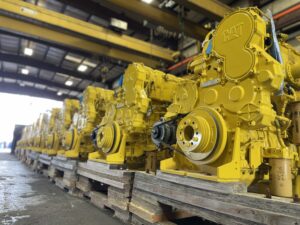
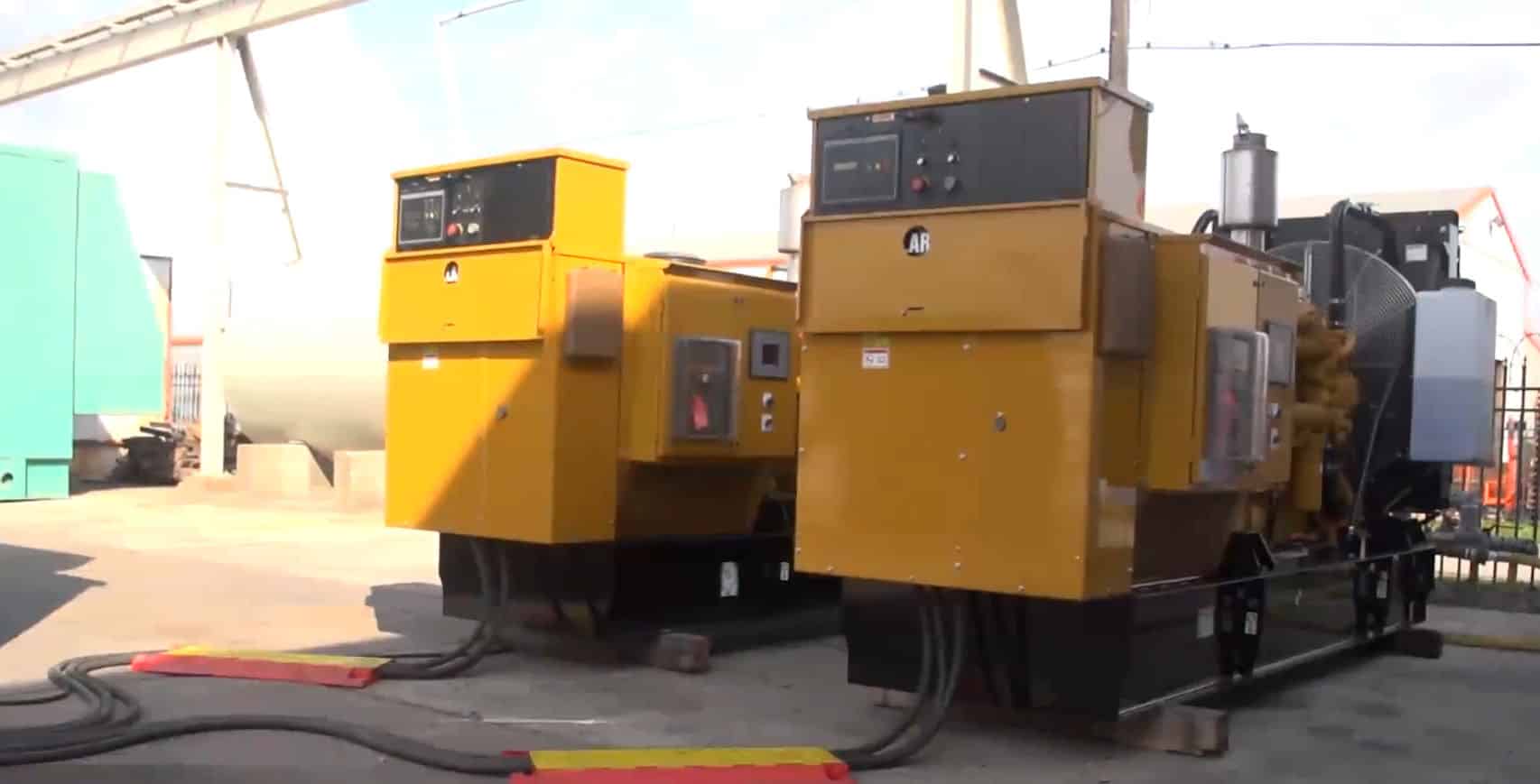
Depco’s 30,000-square-foot Houston yard is built around this principle. The facility includes two load banks (750 kW and 2 MW) plus a dyno cell for engine testing, and a significant portion of inventory is bench-tested and certified before shipment. Test reports are provided by serial number with the unit.
Frequently Asked Questions
How often should I load bank test my generator?
If your generator reaches at least 30% of nameplate kW during routine monthly exercise (or reaches minimum exhaust gas temperature), NFPA 110 does not require an annual load bank test. If it doesn’t hit 30% monthly, which is the case for most standby generators on light building loads, an annual load bank test is required for compliance. Every 36 months, Level 1 EPSS installations require a triennial Class runtime test in addition. Healthcare facilities typically load bank test every 12 months regardless, and many run every 6 months to manage accreditation risk.
How long does a load bank test take?
Plan for 4 to 6 hours on site for a standard annual compliance test: 1 hour for setup, 1.5 to 2 hours for the actual test, 30 minutes for cool-down and shutdown, and the balance for documentation and breakdown. A triennial 4-hour test is a full day.
What size load bank do I need?
Size it to at least 80% of the generator’s nameplate kW, enough to cover the 75% step without running the load bank itself at 100% of its rating. For a 750 kW generator, a 600 kW load bank is the practical minimum; a 750 kW or larger unit is better. If you want to verify full capacity at 100%, the load bank needs to be sized to 100% or more of the generator’s rating.
Can I load bank test a natural gas generator?
Yes. The procedure is the same, though natural gas generators don’t suffer from wet stacking the way diesels do. NFPA 110 monthly exercise requirements still apply (30 minutes at load monthly), and annual supplemental load testing is still required if monthly thresholds aren’t met.
Does load bank testing affect my warranty?
A properly documented load bank test generally supports warranty compliance. Most manufacturers require periodic operational testing as a warranty condition. Test documentation is also useful evidence if a warranty claim is ever disputed. That said, running a generator beyond its nameplate rating, or improperly, can void coverage. Stay within the manufacturer’s operating envelope and keep the records.
What’s the difference between load bank testing and commissioning?
Load bank testing is a specific test: applying a controlled load and measuring performance. Commissioning is the structured lifecycle process of bringing a new or used generator into service, of which load bank testing is one major component alongside mechanical installation verification, controls testing, ATS functional testing, protection testing, and documentation handover. Every commissioning program includes load bank testing; not every load bank test is part of a commissioning program. For the full commissioning picture, see our best practices for testing and commissioning industrial generator systems.
Closing Thought
A load bank test is a few hours and a few thousand dollars. A generator that fails during a real outage, whether at a hospital, a data center, a refinery, or a cold-storage warehouse, is measured in millions of dollars and, in the wrong building, in lives. Every major code body treats load bank testing as required maintenance for a reason.
If you’re running an ongoing compliance program, build the annual load bank test into the facility calendar and the annual budget. If you’re buying a used generator, don’t close the purchase without a test report. Either way, the test is not the expense. The test is the insurance policy.
Depco Power Systems’ Houston testing center is equipped with 750 kW and 2 MW load banks plus a dyno facility, and we test and certify generator sets and engines as part of our inspection and certification process. To discuss a generator purchase or request a test report by serial number, contact our sales team.